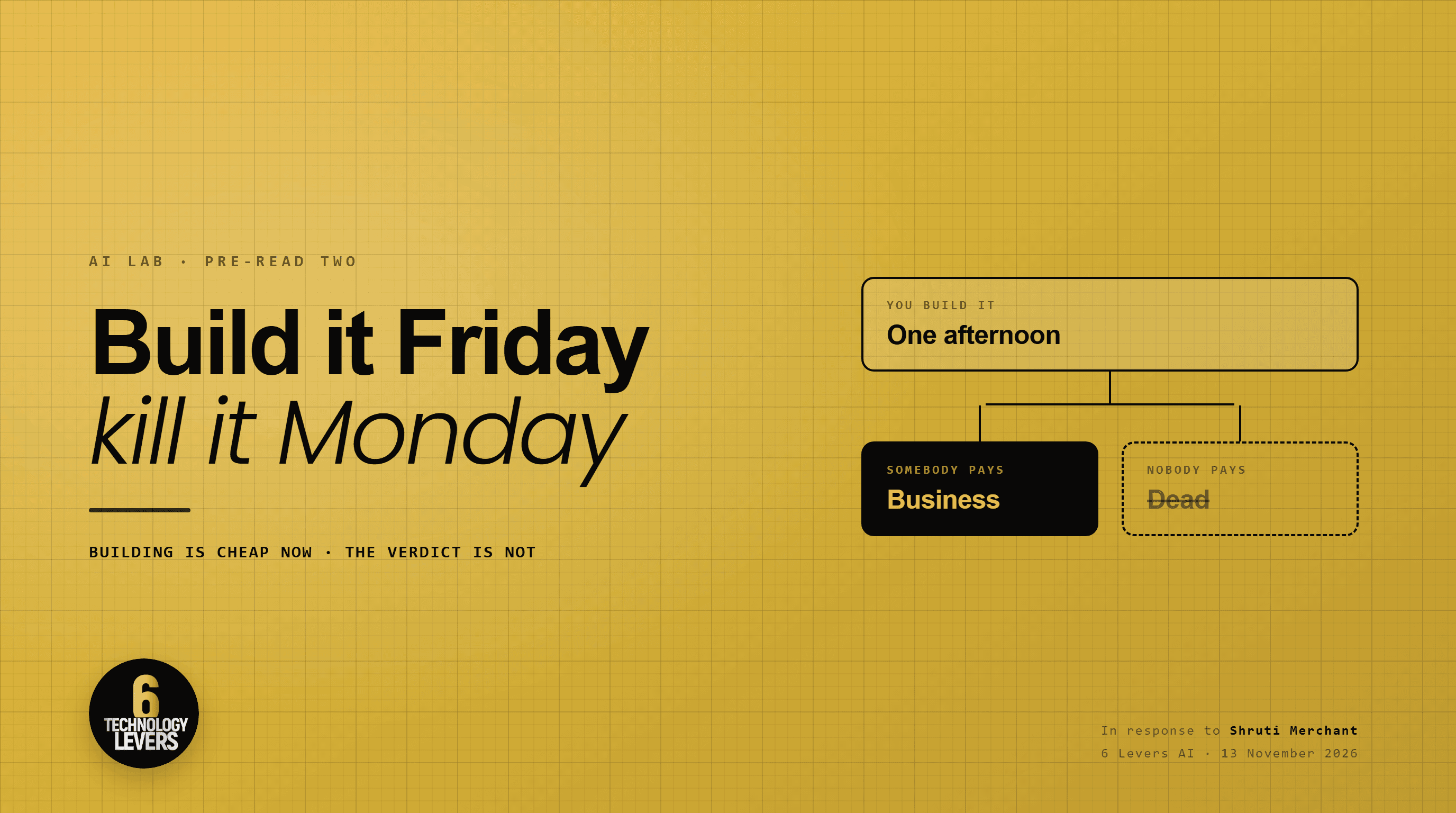
Somebody sent me a video this week about getting to your first hundred thousand in revenue. It is by Shruti Merchant, who founded a coliving company called HubHaus, then started a second company, and is now a partner at Pear. She has taken two companies to product market fit herself, and she nails it.
Her argument goes like this. The founders who stall come up with an idea, decide it is brilliant, disappear for six months to build it, then surface and ask how to get customers. By then they are attached to something nobody wants, so they tweak instead of starting over, and eventually they give up and go back to a job. The founders who make it treat the idea as a hypothesis. They are comfortable being wrong. They talk to dozens of customers. And they get money in hand before a single line of code is written.
I want to add two things to that, because in my own work they have killed more businesses, apps and good ideas than anything else I have watched. Not a bad idea. Not a lack of money. These two.
Killer one: free users
The first is the trap of getting free users to test it and give you feedback.
Testers are not the problem. You need testers. The problem is that a free user has no skin in the game, and a person with no skin in the game will lie to you.
Not out of malice. Out of manners. You have built something, you are standing in front of them with it, you are clearly proud of it, and they are not going to look you in the eye and say this is useless. They will say this is great. They will say send it over. Some of them will mean it. Then they will not open it again, and they will feel slightly guilty about that, and they will avoid the subject next time they see you.
You will record all of that as validation. It is not. Praise is not demand. Enthusiasm is not demand. A reply to your email is not demand. A signup with no card attached is not demand.
You know who will be honest with you? Somebody who has put a credit card on the line. That person will tell you this is trash, I do not need this. And that is useful, immediately, for free. Or they will keep it and say yes, I am willing to pay for this, and that is the only feedback that has ever cost the person giving it anything, which is exactly why it is the only feedback you can trust.
The answer no is not a failure of the test. It is the test working. A no in week one is the cheapest thing you will ever buy.
Killer two: building instead of deciding
The second is newer, and it is specific to this moment. In the age of AI it is very easy to build. So people build, and build, and add a feature, and add another, and look at a competitor and take their features too. And they never go and get the feedback.
That is not iteration. Iteration is a change you make because a paying customer told you something specific was in the way. What I am describing is avoidance. It feels like work, it looks like progress from the outside, and its actual function is to postpone the verdict for another two weeks.
Every feature you add before somebody pays is one more thing you have decided to be right about without checking. You are not reducing your risk. You are compounding it, and you are making the eventual abandonment more expensive, because now there is more to abandon and more of your pride is in it.
If nobody pays, the product is not short of features. The hypothesis is wrong. Those are different problems and only one of them is fixed by building.
Why Shruti's rule needs a small adjustment
Get money before you write a line of code is good advice in a world where writing code costs six months. The rule is not really about code. It is about sunk cost. It exists to stop you spending half a year on an assumption you never checked.
That cost has collapsed. I can build a working version of most ideas in an afternoon now. Not a mockup. A thing that runs, that somebody can use badly and complain about.
Here is the part worth sitting with. For six months you are afraid. You know what it is costing you. That fear is uncomfortable and it is also doing something useful: it keeps the question alive. Does anybody actually want this.
When the build costs an afternoon, the fear never shows up. You are not afraid to start. You are afraid to stop. By dinner you have something that works, and something that works is a thing you can love. People are impressed, because it is genuinely impressive that you made it in an afternoon. And now you are exactly where Shruti's stalled founder was, except it took you one day instead of six months to get there.
The trap did not go away. The entrance just got easier to walk through. So the discipline that matters is no longer restraint before you build. Building is cheap, go ahead and build. The discipline that matters is what you do on the other side.
What it looks like when somebody gets this right
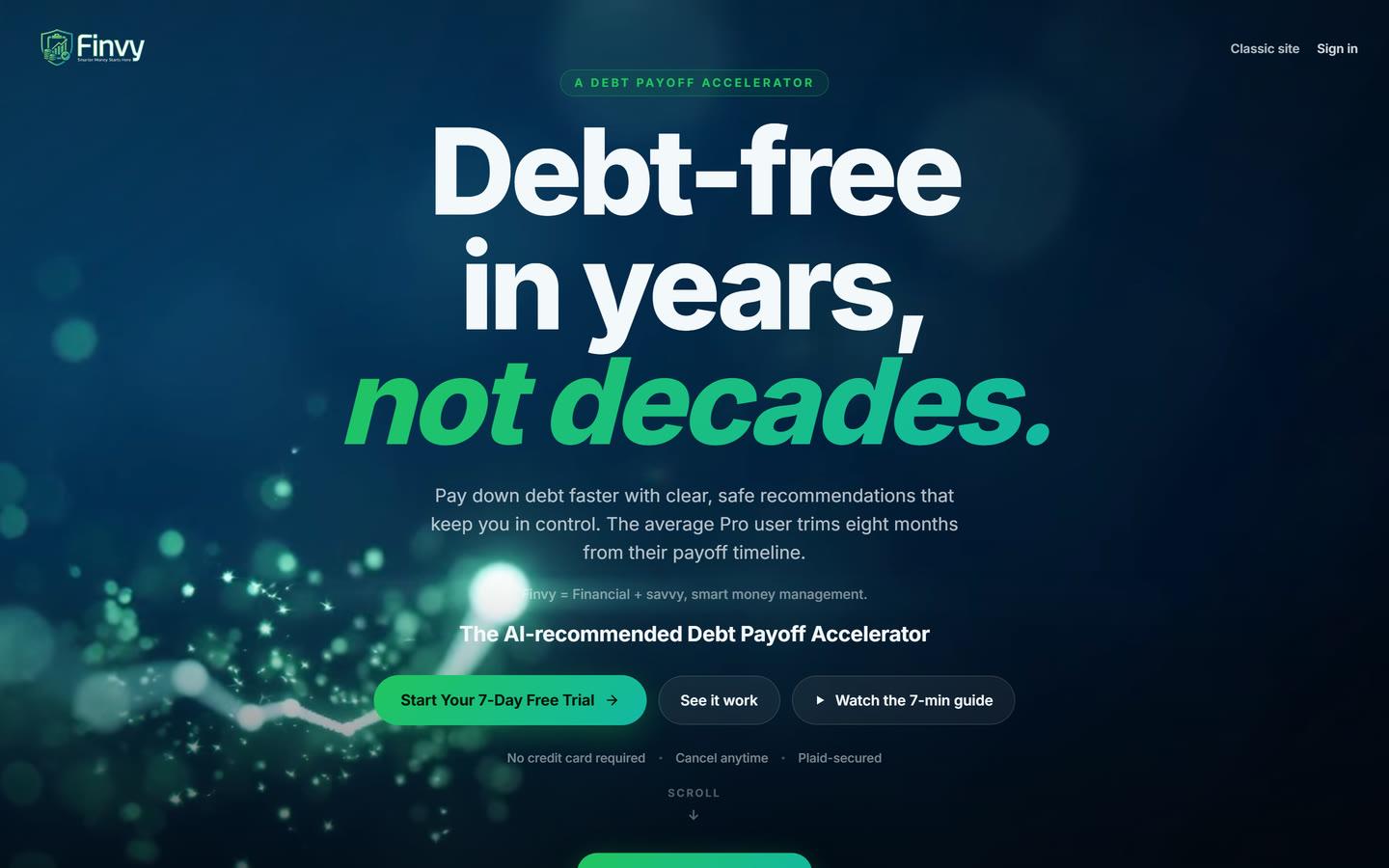
One of our clients, Finvy, did it the right way round. The idea was an AI debt payoff accelerator: an app to help families get out of debt faster and put more into savings.
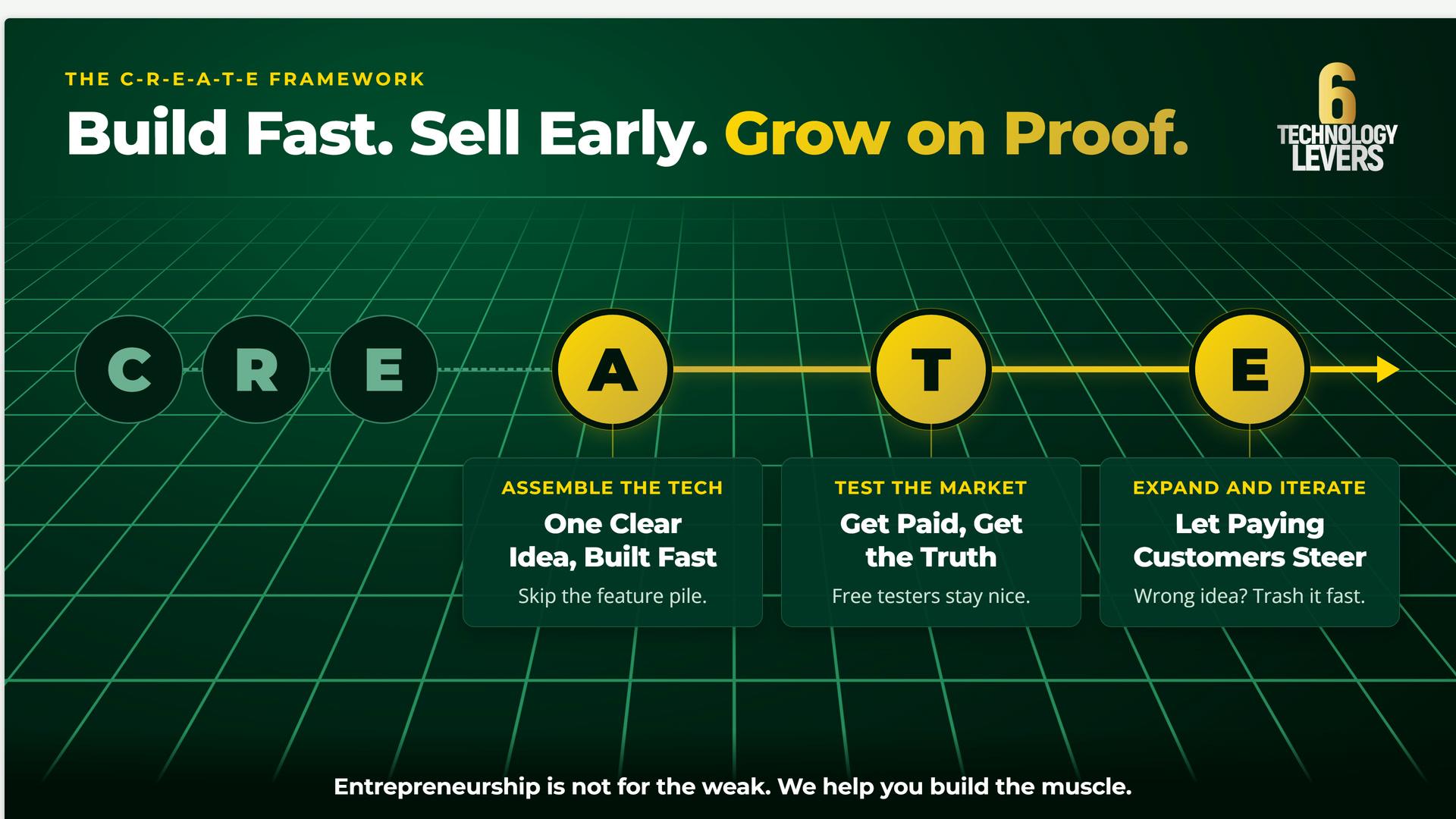
They did not spend a year refining it. Instead of trying to iterate a million things, they had one clear idea. We built it quickly, and they put it in front of real people who could say no.
Two or three months into the market they have product market fit, they have paying customers, and they are growing. They are now getting calls from Fortune 50 companies that want to put the app in front of thousands of their own employees, because those companies can see the value for themselves.
None of that came from another round of features. It came from putting it into the marketplace early enough to find out.

The hard part is dropping it
The founders who make it, Shruti says, are the ones who are totally okay being wrong. They congratulate each other for throwing ideas away. That line goes past quickly in her video and it is the part most people skip.
Entrepreneurship is a good thing. It is not for the weak. Part of what it asks of you is a willingness to accept that sometimes you got the idea wrong, and the faster you can take that idea, bin it and go back to the drawing board, the better off you are.
That is a hard muscle. Dropping an idea is not a mood, it is a procedure, and it has to be done out loud or it does not take. Write down, before you build, who would pay and how much. A name, not a category. Set a date. When the date arrives, say the sentence in front of somebody else: we built it, nobody paid, it is dead. Then go again.
What makes that hard is not the work you lose. It is that saying it out loud feels like announcing you were wrong in public. It is not. It is announcing that you ran the test and read the result, which is the entire job.
What this means on Friday
Ten of us are in a room on Friday morning for three hours, and everybody is bringing one real problem and leaving with something that runs.
Here is your homework, and it takes five minutes.
Before you come, write down one name. Not a market, not a segment, not pastors or nonprofits or small business owners. One human being who has this problem, and the amount you would ask them for. Bring it on paper.
Because on Friday you are going to build something, and the building is the easy part now. What happens next week is the part that decides whether it was worth your Friday. Somebody either pays you or they do not. If they do, you have a business. If they do not, you have an afternoon back and a hypothesis you can stop carrying.
Both of those are good outcomes. Only one of them is a product.
The video that prompted this was made by Shruti Merchant, a partner at Pear VC, and it is worth two minutes of your time on its own. The video version of this piece is at youtu.be/JhLDyL8p564. We help leaders build the muscle described above, and we build the applications that get tested with it.