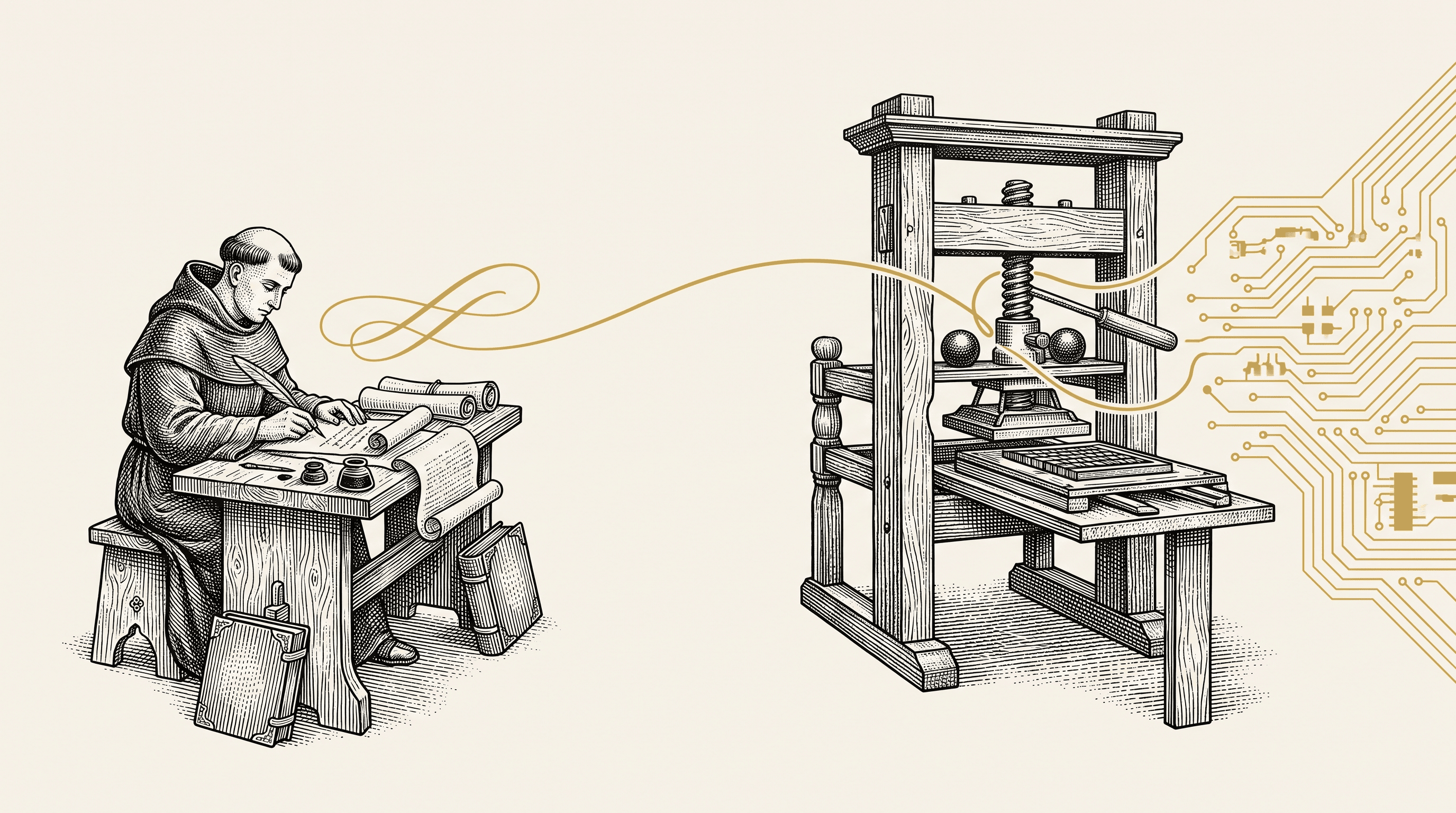
On August 5, the Gospel Coalition drew what it calls a line in the sand. In an article titled "Our Line in the Sand on AI: TGC's Missional Opportunity," senior editor Brett McCracken announced that TGC's writers may not use AI for "ideating, researching beyond a basic fact search, organizing, writing, or editing beyond a basic spelling check." The reasoning is theological. Writing, he argues, is "a holy calling and an act of worship." AI output is "soulless slop." Carey Nieuwhof, one of the most trusted voices in church leadership and a man who has spent two years helping churches adopt AI, reviewed the policy on Instagram and said, "Actually, I think it's pretty great."
If you lead a church, a nonprofit, or a business, you have probably felt the pull of that position. It sounds like faithfulness. Before you adopt it, I want to introduce you to a man who made the same argument, more beautifully, five hundred years ago.
The abbot who defended the scribes
In 1492, Johannes Trithemius, the abbot of Sponheim and one of the most respected scholars in Germany, wrote a treatise called In Praise of Scribes. Copying Scripture by hand, he argued, was not a production method. It was devotion: "What we write we imprint more forcefully on our minds." The new printing presses produced cheap work on paper that might last two hundred years, while parchment would last a thousand. And walking away from the craft was a spiritual failure: "He who ceases the work of a scribe because of printing is not a true friend of Scripture."
Then he had the treatise printed. About thirty printed editions of his writings appeared before the century ended. The man who called the scriptorium sacred used the press whenever it served him, because it worked.
What the Church actually did with the press
Here is the part the popular version of this story gets wrong. The Church never feared the printing press, and it certainly never banned it. The earliest dated piece of European printing is a papal indulgence from 1454. The first printed book was the Bible. Italy's first press operated inside a Benedictine monastery. Cardinal Nicholas of Cusa called printing a holy art.
What the institution did was subtler. It adopted the technology immediately, and then it spent a century deciding who was allowed to speak through it. In 1487 came pre-publication examination of books. In 1501, a papal bull ordered "full control over the printers." In 1515, universal licensing, with penalties running from book burning to excommunication. By 1559 the Index of Prohibited Books banned the complete works of roughly 550 authors, Erasmus among them. And in a detail I find almost unbearably instructive, the 1515 censorship decree opens by praising printing as an invention perfected "with God's assistance."
The institution loved the technology. It wanted to certify the speakers. Keep that distinction in mind; we will need it.
The same sermon, in secular dress
The argument is not even uniquely religious. Every writing technology has been met by the guardians of the previous one, making the same case in the same shape.
In 1888, a writer in the Pittsburgh Christian Advocate defended penmanship against the typewriter: "Penmanship is usually an index to character," and the machine "will never displace penmanship, except in special departments." In 1900, the New Century Standard Letter-Writer ruled it "absolutely bad form and almost impertinent, to use a typewriter in social correspondence." In 1930, a supervisor of writing in the Spokane schools declared a typewriter on every school desk impossible: "From a financial point of view alone, it can never come to pass." In 1983, TIME reported that senior executives resisted keyboards "on the ground that such work is demeaning." In 1995, Newsweek ran a famous essay scoffing at classroom computers: "Who needs teachers when you've got computer-aided education? Bah."
Every one of those sentences was sincere. Every one was published through the very channels it distrusted. And every one of those fears now reads as a costume from another era, because the craft closest to the old process always sacralizes the process, right up until the new tool becomes the craft.
What the Gospel Coalition gets right
Let me be fair, because the fair version is the interesting one. TGC's policy governs their own publication, and a publisher can set any standard it likes for its own pages. After a year of AI scandals in Christian publishing, tight guardrails are a defensible editorial call. Their concern about slop is not imaginary; neither was Trithemius's, since early print really was flooded with cheap, error-ridden editions. TGC also says plainly, "We're not anti-tech. We're pro-human," and they mean it; they run an AI education cohort and AI podcasts even as they fence AI out of their writing process. Even sympathetic critics have noticed the tension. The writer Aaron Renn called tight guardrails "entirely reasonable" while admitting he is "extremely skeptical of their spiritualized claims" about writing.
That is the precise shape of 1492. Sacralize the old process. Declare the new medium's output soulless. Keep using the technology yourself.
Where the line actually belongs
The flaw in TGC's position, and in Carey's endorsement of it, is not the rules. It is the theology wrapped around the rules. A workflow got promoted into a doctrine. Writing became worship, which made the tool's output a rival soul, which made banning it from even research and idea work feel like fidelity. Five centuries of evidence say this move fails, every time, and that the Gospel advances through the new medium anyway, fastest through the people who pick it up with discernment.
Tools are not holy, and tools are not soulless. Tools are stewarded well or stewarded badly. So draw lines, absolutely. But draw them around the things Scripture actually asks you to protect: truth, honesty about what you used and how, the care of souls, and the data your people trusted you with. A line drawn there will still be standing in five hundred years. A line drawn around a workflow will read like parchment versus paper.
If you lead a faith-driven organization and you are trying to figure out where those lines belong in practice, that is the work we do every week. Book a strategy session at 6leversconsulting.com. About 30 minutes, no pressure. Bring your hardest question and you will get a straight answer.
The receipts
Every quote in this piece was verified at the source before publication. Here they are, so you do not have to take my word for any of it:
- The Gospel Coalition, "Our Line in the Sand on AI: TGC's Missional Opportunity," August 5, 2026 (the policy, "a holy calling and an act of worship," and "soulless slop")
- Johannes Trithemius, In Praise of Scribes (De Laude Scriptorum), written 1492, printed 1494 (English translation on the Internet Archive; the Latin first edition is digitized at Heidelberg University Library)
- Fifth Lateran Council, Inter sollicitudines, May 4, 1515 (universal licensing, the penalties, and the opening praise of printing as perfected "with God's assistance")
- George Haven Putnam, The Censorship of the Church of Rome, vol. 1 (the 1487 examination requirement, Alexander VI's 1501 "full control over the printers," and the Index)
- Penman's Art Journal, vol. 12, March 1888 (the Pittsburgh Christian Advocate's defense of penmanship against the typewriter, reprinted as "The Pen Still Supreme")
- The New Century Standard Letter-Writer, 1900 (typewritten social correspondence as "absolutely bad form")
- The Business Educator, vol. 36, 1930 (the Spokane supervisor of writing on why a typewriter on every desk "can never come to pass")
- TIME, "The Computer Moves In," January 3, 1983 (executives resisting keyboards as "demeaning")
- Newsweek, Clifford Stoll, "Why the Web Won't Be Nirvana," 1995
- Aaron Renn, "Christians and AI" (the sympathetic critique of TGC's "spiritualized claims")
- Pontifical Council for Social Communications, The Church and Internet, 2002 ("There are no sacraments on the Internet," quoted in the video version of this argument)